Reframing Gut Feelings in Maternity and Neonatal Care as Data
Jun 23, 2026
First published by Lottie King on LinkedIn, June 2026.
When a parent says "something is wrong", what happens next tends to go one of two ways. Either the information is investigated, with testing, listening, and an attempt to understand what exactly does not feel right. Or the parent is classified as anxious and the concern is closed.
The neuroscience tells us the second response is a measurement error. Here is why, and here is what to say instead.
Where this sits right now
This piece was written in the week the largest maternity review in the history of the NHS was due to report. Donna Ockenden's independent review into Nottingham University Hospitals, examining around 2,500 families' cases of stillbirth, neonatal death, and serious harm to mothers and babies, was scheduled to publish on 24 June 2026, with the Baroness Amos report on Maternity and Neonatal Services in the UK following shortly after.
One of the consistent themes I have seen throughout the reviews over the last decade, in my work with neonatal parents, and in my own experience, is the invalidation and dismissal of symptoms.
We often hear the phrases "something is wrong", "something doesn't feel right", or a version of this. And usually, these can go one of two ways. Either the information presented to the clinical team is investigated, with testing, listening, and an attempt to understand what exactly does not feel right, or we see what these reports describe again and again: parents dismissed as anxious, the symptoms or the changes in their baby invalidated.
When we hear a parent talk about gut feelings, or mother's and father's instinct, it is not as simple as labelling it anxiety. It is information. It is raw data, coming from the body. A body that has either known itself for the number of years the parent has been alive, filled with rich lived experience, or a parent who has deeply studied their baby on the unit, where continuous streams of information about that baby are entering the body, more than anyone can consciously hold at any one time.
So when we dismiss this, we are making a measurement error. And when we look at the neuroscience of interoception, we can understand why. Below I want to share that neuroscience, how we manage that data, and how we can support.
The signal is the key
Interoception is the afferent sensing of the body's internal physiological state, the continuous traffic of signals from viscera, receptors, internal organs and tissues that ascends via spinothalamic pathways and vagal afferents and is integrated cortically in the insula (Craig, 2002; Craig, 2009). It is a genuine sensory modality, as real as vision or proprioception, simply pointed inward. "Gut feeling" is not a figure of speech. It is a description of an internal pathway.
And this matters, because it means a parent's "something is wrong" is not, by default, an emotional embellishment laid over a neutral situation.
Seen this way, instinct is rapid bodily-signal detection combined with pattern recognition that is not yet available in words (Berntson & Khalsa, 2021; Feldman et al., 2024). A parent at the cot side, hour after hour, is building an enormous, fine-grained dataset on this one specific baby: the usual colour, the usual tone, the ordinary rhythm of breathing, the normal quality of a cry. There is also reason to think pregnancy itself sharpens this sense: interoceptive sensibility, the self-reported tendency to notice internal bodily signals, appears generally heightened during pregnancy, with higher interoceptive sensibility in early pregnancy associated with lower postpartum depression (Crossland et al., 2022).
So when something departs from that learned pattern, the body can register the deviation before the mind can name it. The certainty arrives first. The explanation, if it comes at all, comes later. This is not a parent being irrational. It is inference running ahead of language. And it deserves to be treated as what it is: an early reading from someone with more continuous observational data on this infant than any single member of staff.
The conscious alarm has already passed the filter
The contemporary, predictive-processing account of emotion sharpens the point. The brain does not passively receive bodily signals. It continuously predicts the body's state and compares prediction against incoming data. Emotion, on this account, is the brain's inference about those interoceptive signals: emotion as interoceptive inference (Seth & Critchley, 2013; Barrett & Simmons, 2015).
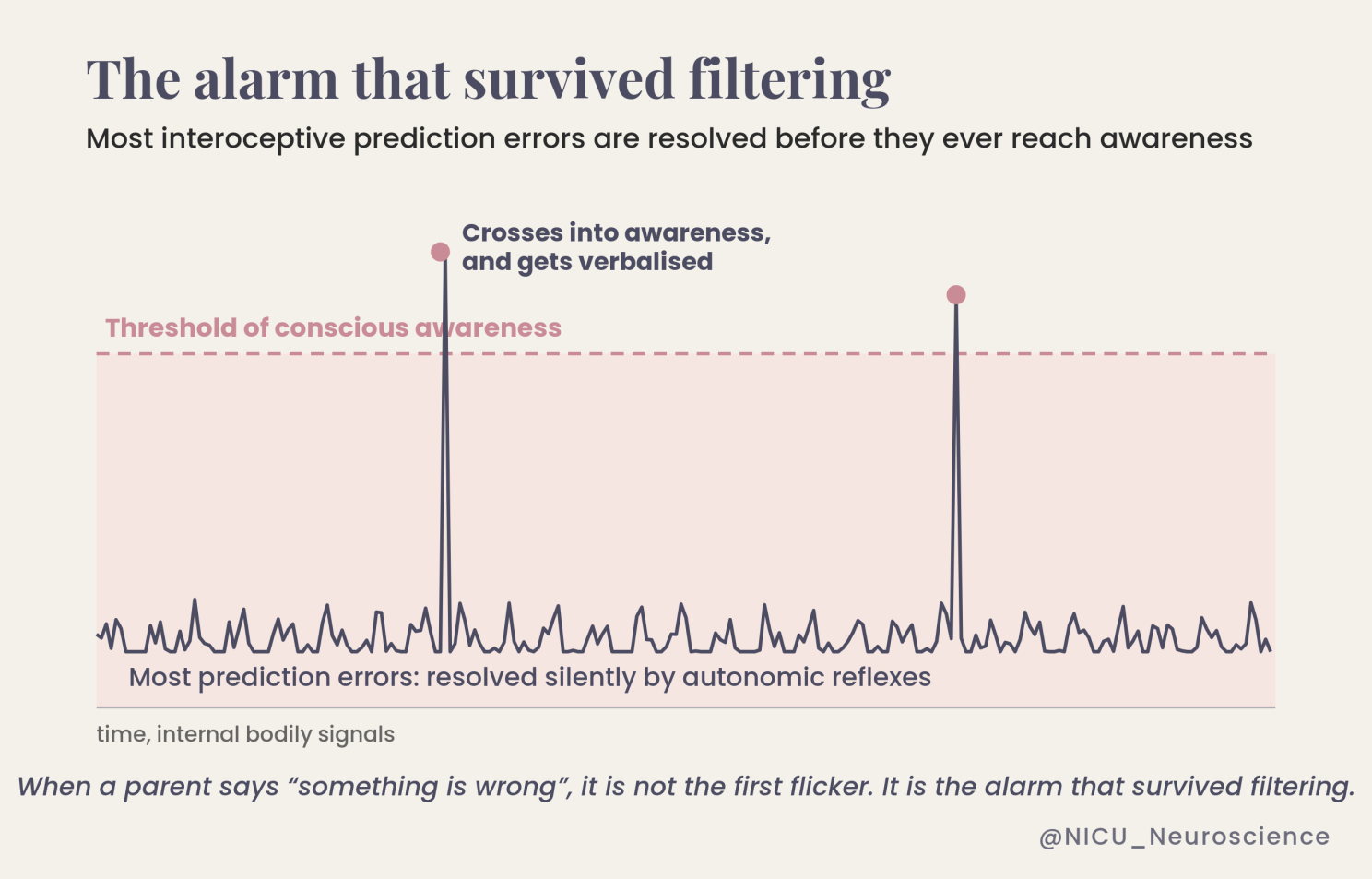
The clinically relevant detail is what happens to the mismatches. Small interoceptive prediction errors are resolved continuously and silently by autonomic reflexes. A signal only ascends to conscious awareness when it is large or persistent enough that those automatic mechanisms cannot absorb it (Owens, Friston & Low, 2018). Attention then up-weights its precision (Ainley, Apps & Fotopoulou, 2016). In other words, by the time a parent consciously registers and verbalises "something is wrong", the underlying signal has already cleared a high internal threshold. It is not the first flicker of worry. It is the alarm that survived filtering.
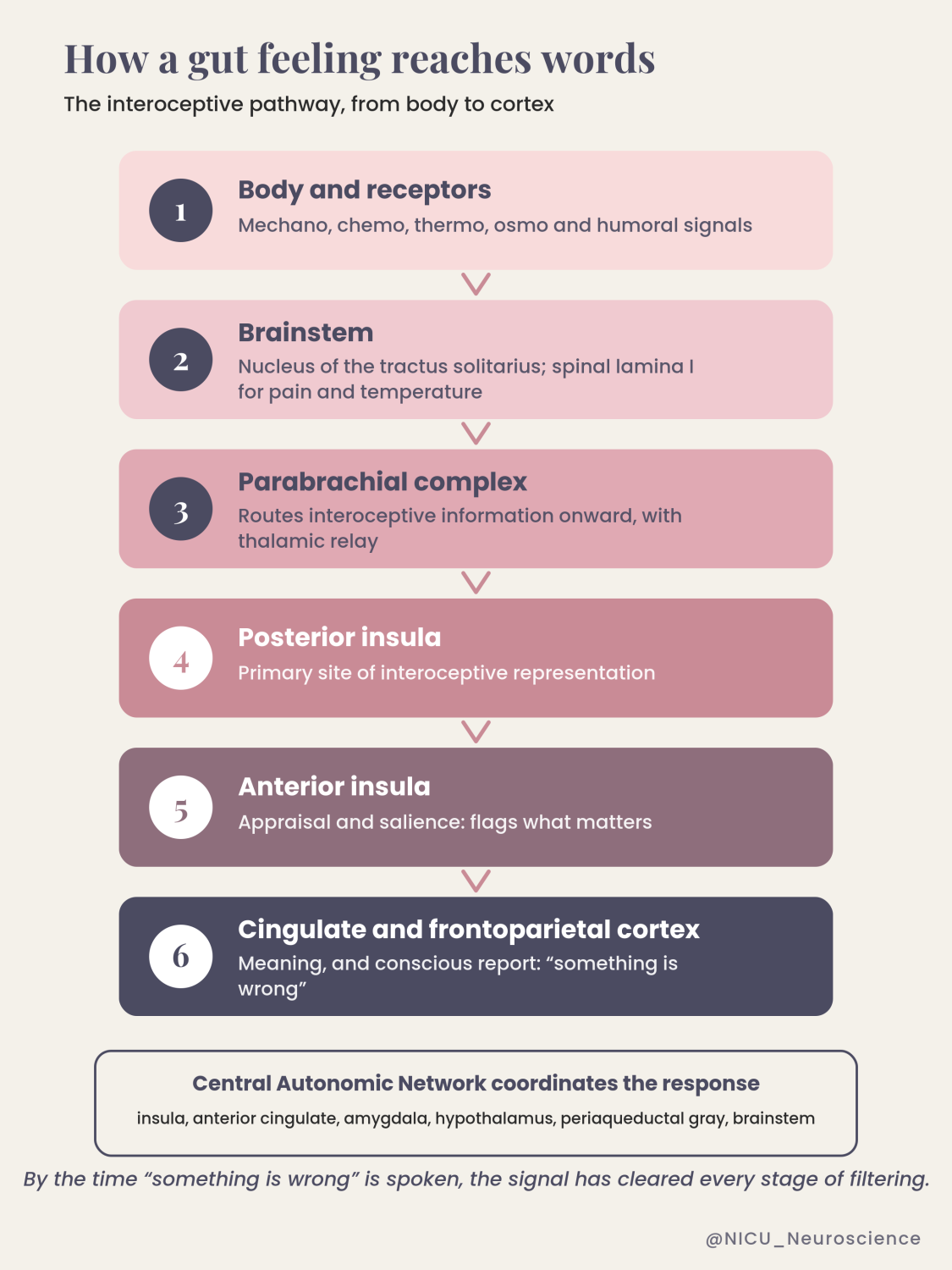
It is worth tracing that pathway, because it shows how much processing precedes the words. Visceral afferents ascend through the brainstem, relayed prominently via the nucleus of the tractus solitarius, with pain and temperature signals travelling spinal lamina I routes. The parabrachial complex then routes this information onward, with thalamic relay, to the posterior insula, commonly described as the primary site of interoceptive representation. From there the anterior insula adds appraisal and salience, flagging what matters, before cingulate and frontoparietal systems attach meaning (Craig, 2002, 2009; Berntson & Khalsa, 2021; Lamotte et al., 2021). Coordinating the response is the Central Autonomic Network: the distributed system spanning insula, anterior cingulate, amygdala, hypothalamus, periaqueductal gray and brainstem nuclei, through which the brain turns integrated bodily evidence into patterned autonomic, endocrine and behavioural output (Benarroch, 1993; Lamotte et al., 2021). By the time "something is wrong" is spoken, the signal has travelled the full length of this architecture and survived every stage of filtering.
Why "anxious parent" is the wrong label
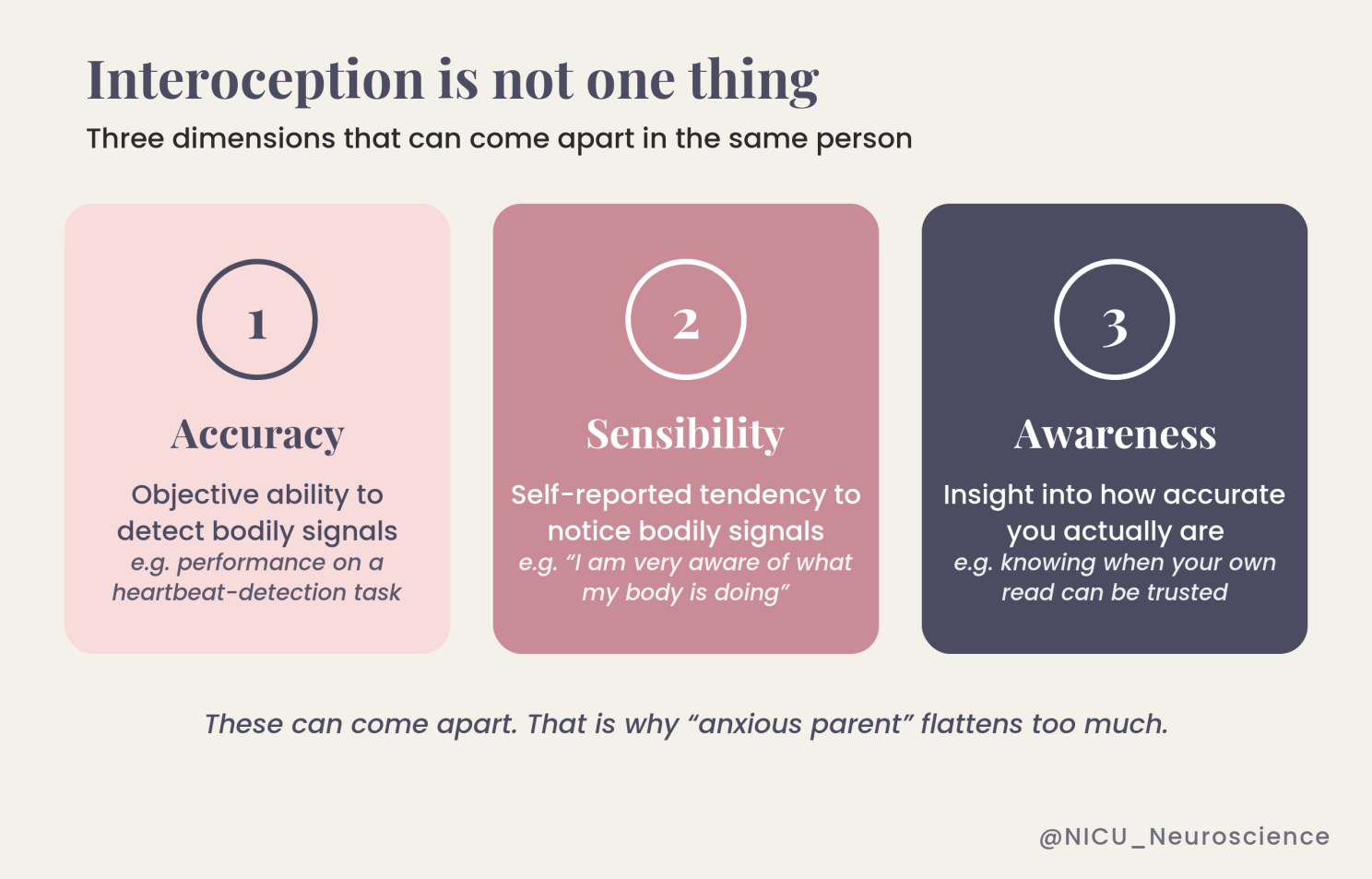
Interoception is not one ability, and this is where clinical language can go wrong. Research distinguishes at least three dimensions: accuracy, the objective ability to detect bodily signals; sensibility, the self-reported tendency to notice them; and awareness, the insight a person has into how accurate they actually are (Garfinkel et al., 2015).
These can come apart. A parent may report intense bodily sensitivity alongside only moderate objective accuracy, or show good accuracy paired with very low confidence. A mismatch between what is perceived and what is measured has itself been linked with anxiety-related difficulty (Ventura-Bort et al., 2021).
So when we reach for the phrase "anxious parent", we are collapsing several different things into one word. A more precise question is this: for this person, what is the relationship between detection, interpretation, and confidence under sustained autonomic load? A mother who asks for reassurance again and again may not distrust the team at all. Her arousal may be degrading the clarity of her own internal signals, so she keeps checking them against an external source.
The same literature shows that anxiety can itself be a state of noisy or misweighted interoception: prediction and signal decoupling, errors over-weighted (Paulus & Stein, 2010). This is usually deployed against parents: see, it is just anxiety. But follow the logic. If accurate alarm and anxious misreading are generated by the same neural machinery, then "anxious" cannot discriminate between them. It is not a finding that rules anything out. You cannot label your way to a differential diagnosis.
This is the crux. Recording "maternal anxiety" and acting as though the question is now closed does not resolve the uncertainty. It collapses signal and noise into a single bin and then discards the bin. The only way to tell a true positive from a false alarm is to treat the report as data and investigate it. "Anxious", used as a reason to stop looking, is a measurement error wearing the costume of a diagnosis.
Matrescence, patrescence, and a nervous system retuned for exactly this task
There is a further reason to weight a parent's signal heavily rather than discount it: their nervous system has been structurally reorganised for detection.
We have a term for the developmental transition into motherhood, matrescence, named by anthropologist Dana Raphael in the 1970s, and it has a measurable neural signature. Across pregnancy the brain undergoes substantial structural change, particularly in regions subserving social cognition. These changes persist for at least two years postpartum and predict the strength of mother and infant attachment. The pattern resembles the synaptic fine-tuning of adolescence: specialisation, not deficit (Hoekzema et al., 2017). The lazy shorthand of "baby brain" describes, in fact, a brain being optimised.
Patrescence, the transition into fatherhood, is quieter but real. Fathers' brains also remodel across the transition to parenthood, with structural change linked to oxytocin, caregiving involvement and bonding (Kim et al., 2014; Saxbe, Martínez-García et al., 2023). Across both parents, the caregiving brain organises around a salience and vigilance network: amygdala-centred circuitry that rapidly flags survival-relevant infant cues and supports near-automatic detection of, and response to, infant distress (Abraham et al., 2014; Dufford, Erhart & Kim, 2019). And this tuning is experience-dependent: the more a parent cares for their infant, the stronger their brain's infant-specific responses become (Abraham et al., 2014).
The implication for the bedside is concrete. The parent at the incubator, or the woman reporting that something about this pregnancy has changed, is not a layperson with a hunch. She is a continuously calibrated instrument that has been monitoring this specific baby longer and more closely than any of us. When she reports a deviation, she is reporting a change in a baseline only she holds.
Dismissal is never neutral
There is a relational layer here that the evidence takes seriously. Emotions are largely experienced in relationship, not in isolation. When someone shares distress and receives cues that their feeling is incorrect, too much, or unreasonable, they experience emotion invalidation, and greater perceived emotion invalidation is associated with emotion dysregulation and symptoms of emotional distress in its own right (Veilleux & Zielinski, 2018). At the level of the nervous system, a dismissive response is not an absence of action. It is an input. It adds social-sensory evidence that the situation is unreadable and that the parent's own signals cannot be trusted, which heightens threat inference and erodes trust at the same time (Harricharan et al., 2021).
This is the reframe I most want teams to hold. A dismissed concern is not a non-event that simply passes. It is a small act of teaching, and what it teaches is doubt. A collaborative response does the opposite work, and it costs no more time.
Detection, or a prediction shaped by fear?
Receiving instinct as data does not mean treating every report as accurate. It means evaluating rather than ranking. The distinction worth keeping is between accurate detection of a real change and threat-conditioned prediction, because from the inside both arrive as certainty (Wilkinson et al., 2017). After preterm birth or a NICU admission, the nervous system has learned that uncertainty can precede deterioration, so heightened vigilance is an adaptive learning outcome, not a fault.
And this is exactly why dismissal is the wrong instrument. We cannot reliably separate detection from prediction by deciding the parent is anxious. We separate them by examining the signal, which requires taking it seriously enough to look. The work is not to judge the feeling. The work is to turn the feeling into something we can evaluate together.
What the inquiries keep telling us
This is where the science meets the reports, and the reports are unanimous.
Bill Kirkup's 2015 investigation into Morecambe Bay found a pattern of concerns not acted upon and a pursuit of "normal birth" that overrode clinical signals, contributing to the deaths of mothers and babies. The 2022 Ockenden review into Shrewsbury and Telford, where 201 babies and nine mothers might have survived with better care, described a culture of not listening and, at its most damning, a tendency to blame mothers for outcomes. Months later, Kirkup's East Kent investigation found that well-founded concerns were too often dismissed or ignored, with women disbelieved when they reported symptoms such as reduced fetal movements or that pain relief was not working. Kirkup gave that report a title that, for our purposes, says everything: Reading the Signals.
The throughline is not, primarily, a deficit of compassion, though compassion failed too. It is an epistemic failure: valid data, repeatedly generated by parents, was repeatedly classified as emotion and discarded. Kirkup's own warning after East Kent was that the same themes keep recurring across inquiry after inquiry. As the Nottingham review reports, and as Leeds begins, the question for our professions is whether we will keep treating this as a recurring surprise or finally recognise it as a systematic error in how we handle a particular class of clinical information.
Turning a feeling into data: the wording that helps
Here is the practical heart of it. If the instinct is a reading from a noisy but well-placed instrument, our job is to help that instrument report clearly. Science-informed wording does three things in sequence: it receives the signal without ranking it, it converts a vague sensation into specific data points, and it makes the evaluation visible so the parent sees their signal being taken seriously. Each step has language that supports it.
First, receive the signal as legitimate information. Before anything else, name that the report counts.
"You know your baby better than anyone. If something feels different to you, that matters to me. Let's explore it together."
Second, turn the sensation into data. A parent often cannot answer "what is wrong", because the change has not reached words yet. This is partly a matter of emotional granularity, the precision with which we differentiate internal states. Under high load the system defaults to broad categories, so the detail has to be drawn out rather than demanded (Feldman et al., 2024). Ask questions that convert a global feeling into observations, the same way you would help any instrument resolve a reading.
"What feels different from yesterday or earlier on? Is it her colour, her breathing, how she is moving, the way she is crying, how she is feeding, or just a sense overall that you can't quite put your finger on?"
Notice what this does. It does not ask the parent to justify a feeling. It offers a small menu of observable channels and lets them point. This respects the science: the detection is real, but the labelling of it needs scaffolding under load, because fine discrimination is exactly what sustained stress degrades (Lamotte et al., 2021; Feldman et al., 2024).
Third, reflect it back without ranking it. Repeat what you have heard as data, not as a verdict to be graded.
"So she feels less responsive to you today than she was this morning, that's what is worrying you? Okay, let's go through everything together and see what we can find."
Fourth, make the evaluation visible. The phrase "let us look at this together" is not a soft nicety. It is joint appraisal: it preserves dignity, supports regulated inference, and allows the concern to be checked without implying it is either correct or foolish (Harricharan et al., 2021; Bottemanne, 2025).
"I'm going to go through each observation on this chart, and in her notes, let's go through this together, let's analyse it and look at any changes, and I'll explain those changes as we go through."
Fifth, close the loop, whatever the finding. A signal that reaches someone and is acted on stays trustworthy, even when the result is reassuring. This is how we keep a parent's detection switched on rather than slowly teaching them to silence it.
"Ok we've taken a look at everything, and you were right, there was a change."
Or
"Ok, we've taken a look at everything and I can't quite find anything in the numbers yet, but I'm going to keep looking and keep telling me what you're feeling."
And where it helps, lend language to the feeling itself. Under high load the system defaults to broad categories, so a parent may only be able to say "I feel bad" or "something is wrong" (McEwen, 2007). This is where an emotion wheel can help a parent articulate what is happening for them.
Because helping differentiate is not correcting them. Fear usually calls for predictability and information. Guilt may call for reattribution. Grief may need acknowledgement rather than a solution. Refining the word can refine what we offer those parents in response (Feldman et al., 2024).
What to retire, and what to reach for instead
Some habitual phrases can sting, because they rank the signal instead of receiving it. Underneath the swap is a simple principle.
A reassuring phrase is a top-down cognitive appraisal we are asking the parent to adopt. But a parent in high arousal is running on bottom-up signals, and top-down reassurance only lands once the bottom-up alarm has been acknowledged and the physiology has begun to settle (Barrett & Simmons, 2015; Seth & Critchley, 2013). Receive the signal first, and the reframe has somewhere to land.
Instead of: "Try not to worry, the numbers look fine."
"The numbers look reassuring to me, if they change between these parameters then I will change this setting, but tell me what you're noticing?"
Instead of: "You're an anxious first-time mum, that's all this is."
"You are noticing a lot, and that makes sense right now, sometimes we just 'know' something is wrong. Let's take a look at what we can test for and check and go from there."
The difference between the two examples is not warmth. The first phrase is often said warmly and well-meaning. The difference is that the adapted version treats the parent's interoceptive report as data to be evaluated, and the original treats it as anxiety to be soothed away. One keeps the early-warning system in the room. The other slowly switches it off.
Why this is safety, not soft skills
It would be easy to file all of this under bedside manner. It is not. A parent's instinct is, in effect, a continuous monitoring stream on a single patient, generated by an observer with unmatched exposure to that baby's baseline. Treated as data and evaluated well, it can surface change earlier than intermittent observation alone. Treated as anxiety and dismissed, it goes quiet, and we lose the stream precisely when we might need it most.
Gut feelings are not a verdict we must obey, and not a worry we must manage. They are a signal we are lucky to receive. Our task is to honour them the way we honour any clinical data: take the reading, ask the questions that sharpen it, check it openly, and report back. Do that, and a parent learns that their body's knowledge is welcome here. That is not only kinder. It is safer for the baby in the cot.
What this looks like in practice
The reframe is not a call for more reassurance, or a poster about kindness. It is a call to reclassify parental report as clinical data and route it accordingly.
- Treat a parent's report of change as you would an abnormal trend in observations: a trigger for assessment and, where indicated, escalation, not something to be talked down.
- Document the concern as a finding, not a temperament. "Mother reports reduced movements / that baby is 'not right', assessing" carries information forward. "Anxious mother, reassured" can create invalidation.
- Replace the question "Is this parent anxious?" with "What is this signal, and have we excluded what it could mean?" The first question closes down the concern whereas the second one allows it to be explored.
- Weight experience. A parent's read of their own baby or body is fine tuned, and a parent's "this is different" is high-precision data about a baseline we do not have.
This offers better measurement. We have spent a decade producing inquiries that say, in effect, the signal was there and we filed it under anxiety.
The neuroscience now explains why the signal was real, why it reached us already filtered, and why the label we reached for could never have been the answer. Reading those signals is not extra work layered on top of the clinical task. It is the clinical task.
To colleagues in maternity and neonatal care: the next time the word "anxious" is spoken or written, treat it as a prompt to investigate, not to conclude.
That single change in how we classify what a parent tells us may be the most evidence-based thing we do all shift.
This is Nervous System Informed Care, and my passion.
Lottie