Scaffolding the autonomic nervous system in maternity and neonatal care
Jul 07, 2026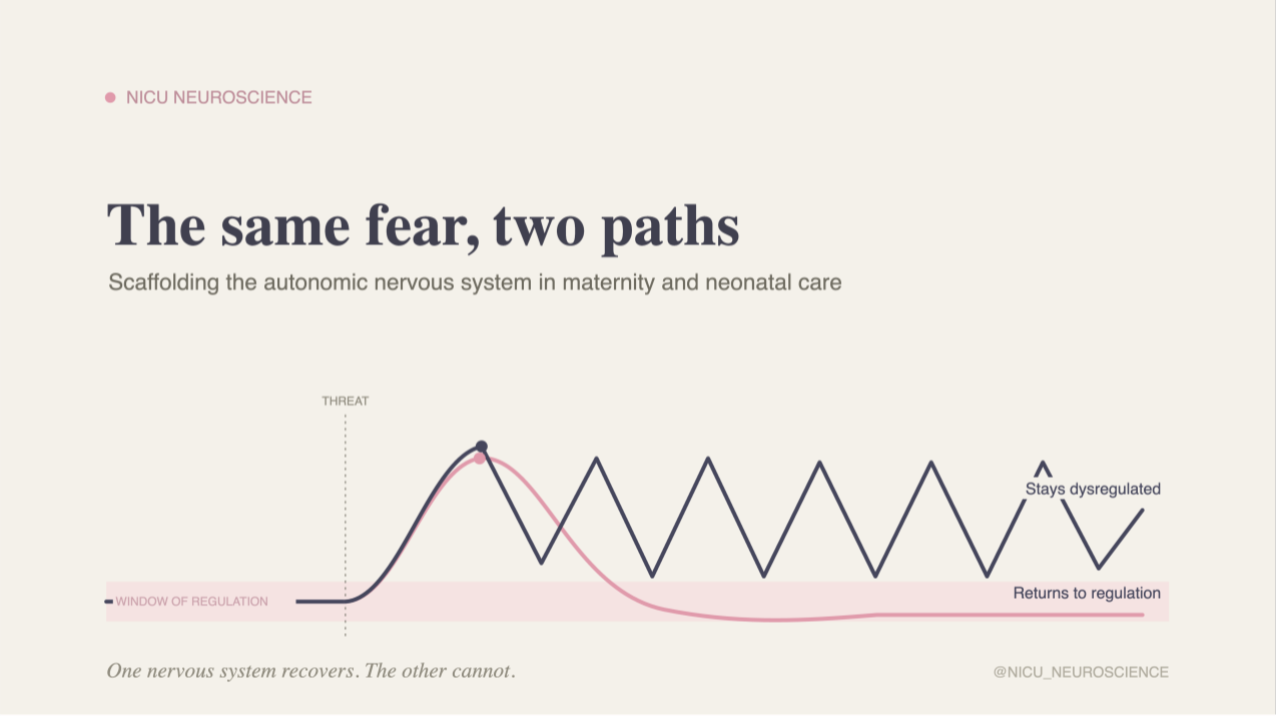
A frightening event is not, on its own, a psychological injury. Whether it becomes one is decided by something else, and that something else is largely in our hands.
I have sat this last week or so with the Ockenden report. It was vast, deeply harrowing, and an explicit account of care failings that altered the lives of so many.
As I worked my way through it, I began visualising the autonomic nervous system responses. The firing of mobilisation. The collapse into tonic immobility. The fear, the freeze, the changes happening in the body in real time to what was being endured. I could read the thresholds for safety not being met, and why. The lack of resources available in the body at that time. I experienced this myself, and have seen it in countless neonatal families I have cared for.
We saw concerns raised and not heard, leading to life-altering outcomes. Parents left alone at the most frightening and vulnerable points of their lives, during a significant window of malleable neuroplasticity. Choice and control stripped away.
These are described, rightly, as failures of process and culture. They are also something more precise. They are the exact conditions that turn frightening into traumatic, leaving the body exposed and its survival responses thwarted. That is one of the key markers of a trauma response held in the body.
So I did what I do when I am trying to make sense of something. I mapped it. I took one frightening event, the kind that happens every day in maternity and neonatal care, and I drew it twice. The same surge of fear, the same emergency. In one, the parent is scaffolded. In the other, they are left exposed.
The two graphs in this piece are the result, and the space between them is the whole argument. Whether a frightening event becomes a lasting injury is decided far less by the fear itself than by what we place around it. That is what scaffolding the autonomic nervous system means, and it is what Donna Ockenden and the incredible families who shared their experience show us happens when it is missing.
The same event, two very different outcomes
Picture two parents in the delivery room, or on the NICU, meeting the same moment.
A sudden deterioration. Alarms. Quick movement. Fast talking. A rush of people into the room. Decisions being made in a life or death scenario. Loss of control. A resuscitation an arm's length away. The experience is too much, too soon, a loss of agency and power, where the autonomic nervous system does not have the resources it needs to navigate what is happening.
Months later, one parent is slowly recovering, finding capacity in their container, healing.
The other is hypervigilant, grappling with shame, guilt and anger. Their self worth has deeply diminished. There are continued headaches, tension, isolation, and a struggle to be comforted by family, friends and professionals.
They endured the same event but have two completely different experiences within the body. Those are the two graphs, and everything that follows is an explanation of why they diverge.
We tend to assume the difference must be the size of the fear, how big the trauma was, or how resilient someone is by nature. In the autonomic nervous system, it is neither. The variable that decides whether a frightening experience is laid down as a hard memory the body can recover from, or as trauma it cannot settle from, is what the body meets in the moments around the fear. Whether it was believed. Whether it was scaffolded. Whether it had any say at all.
We can all be scared
A frightening event, on its own, is not a psychological injury.
The body is built for fear. The stress response is designed to surge, to mobilise, and to come back down once the demand has passed. This is acute stress, the short-term stressor response we are evolutionarily designed for.
The autonomic nervous system does not do this alone. Peter Levine describes it as one part of what he calls the Core Response Network: a set of interlocking systems, including the autonomic nervous system, the emotional and limbic systems, the reticular arousal systems and the instinctual brain, that meet threat as one functional whole and, in health, return to equilibrium together (Levine, 2010; Payne, Levine and Crane-Godreau, 2015). When we talk about a nervous system settling, we are really talking about this whole network coming back to rest.
Whether the body can return to baseline depends on a small number of things: felt safety, a co-regulating presence, a sense of control, and a felt knowing that the threat has passed and is no longer present, not just being told so cognitively.
The window
It helps to plot arousal over time against a concept we can call the window of regulation (Siegel, 1999).
Inside the window, a person is settled enough to think, take in information and connect. Above it is sympathetic mobilisation, the fight or flight range. Below it is hypoarousal, shutdown, the collapse range of numbness and disconnection. We are built to move up and out of the window under threat and, crucially, to return to it once the threat has passed.
It is never about being calm all the time. It is about the autonomic nervous system being able to recover from stressors.
The mechanism that brings us back is the vagal brake, the part of the vagus nerve that innervates the sinoatrial node of the heart, our natural pacemaker (Porges, 2011). When vagal tone is high, this part of our anatomy can bring us back into regulation. When we have been exposed to stress and distress for long periods, vagal tone can diminish, meaning the brake is less able to slow the heart rate down.
Under threat the brake releases, so the heart can speed and the body can mobilise. As cues of safety return, it re-engages, the heart slows, and the system settles back into the window.
That return is the entire story. It is the difference between the two paths that follow, and it is what I set out to draw.
Path one: frightened but supported
In the first path, arousal surges upward. We see mobilisation occur. But someone is there. A clinician stays, or enters. They explain what is happening, they listen, and they offer even a small measure of choice. There is a softness in the face, the prosody of the voice is gentle, the pitch is warm, there is compassionate touch where appropriate.
There is a scaffold in place for the autonomic nervous system of that parent.
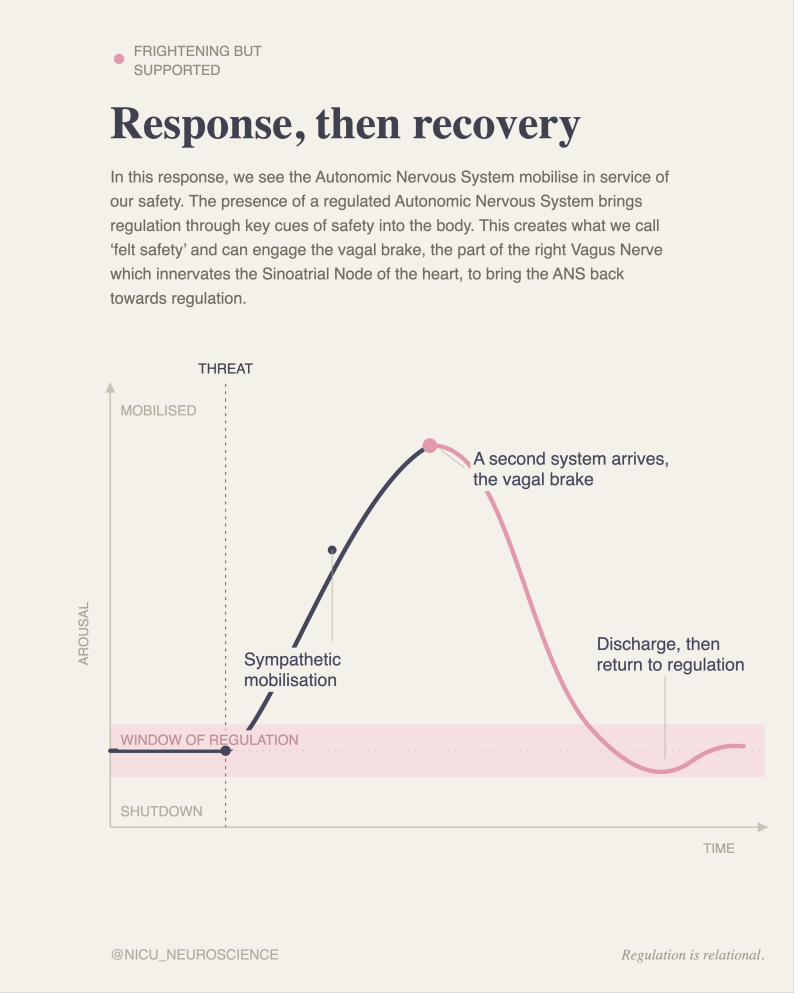
This is where co-regulation does its work, and it is not an abstract or purely emotional idea. Being believed can have a physiological effect.
Words are not just words here. They hold value at a cellular level in the body, and it has a specific neuroanatomy. A regulated nervous system nearby produces a warm face, a voice with melodic prosody, a slower pace, steady eye contact. Perceived through a vast array of sensory information, often below awareness, these are read as cues of safety, and they help the frightened parent's own vagal brake re-engage (Porges, 2011).
Tone of voice and facial expression are not bedside niceties. They are sensory inputs into a parent's cranial and autonomic circuitry. One regulated person can, quite literally, lend their physiology to another.
So the surge completes. Arousal curves back down into the window. The experience was hard, frightening and entirely real, but the response resolved and the body recovered. This is a stress cycle that finishes, the Core Response Network settling back into equilibrium as a whole (Levine, 2010; Payne, Levine and Crane-Godreau, 2015).
It also means a clinician's own state is an active ingredient of care, not a soft one. You cannot co-regulate another nervous system from a dysregulated one. When staff are in sympathetic overdrive or worn to withdrawal, prosody flattens, and the very cues that would settle a parent are no longer there to give.
Staff autonomic states are, in the most literal sense, patient safety conditions.
Path two: frightened, violated and exposed
Now the same surge, but with no felt safety and no co-regulator. The parent is exposed and vulnerable, experiencing too much too soon and for too long, where stress has outweighed the resources available to navigate it. The survival and protective responses are thwarted. Concerns were not listened to, control was taken, and the parent is left feeling exposed and, ultimately, unsafe.
The threat becomes so prominent that a co-activation occurs and a freeze response transpires. Mobilisation is running underneath, but externally we see a parent frozen, or struggling to communicate. Why? Because the threat has been deemed too great to fight against, there is no way to run, and for safety the autonomic nervous system chooses to freeze (Kozlowska et al., 2015).
I use the word violated deliberately. In nervous system terms, in maternity and neonatal care, this is not simply the absence of support. It is the body registering a threat coming from the very people and system meant to keep it safe.
This is the shape I kept meeting in Ockenden. A concern raised and not heard. A parent left alone. Control taken away. Each one is a cue of safety withdrawn at the exact moment the body most needed it.
Uncontrollability and inescapability are among the strongest predictors of whether a threat becomes traumatic (Foa, Zinbarg and Rothbaum, 1992), and here they are layered onto the fear rather than lifted from it.
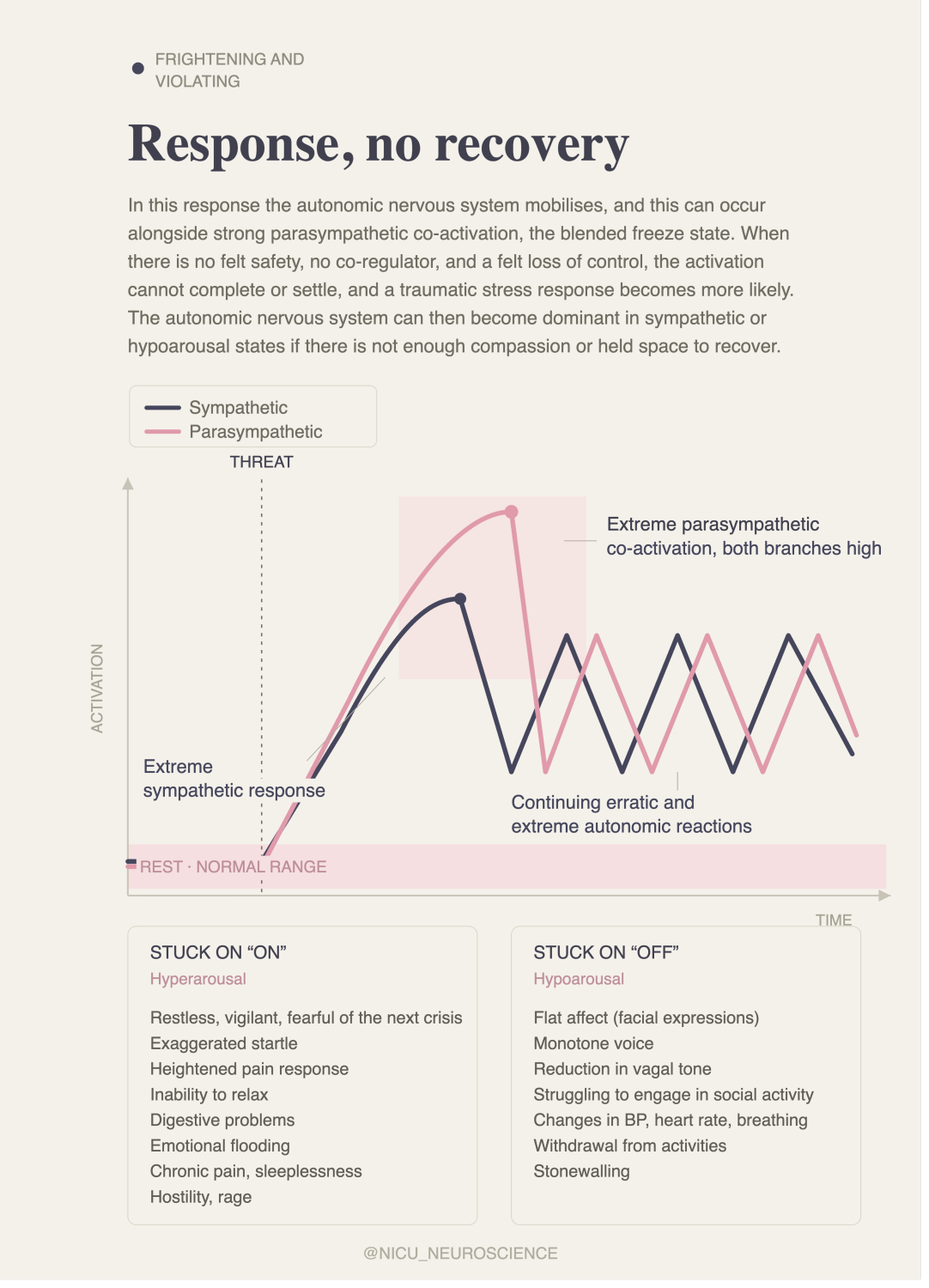
Frightening and violating. Sympathetic mobilisation and parasympathetic co-activation spike together, the blended freeze, and with no felt safety or co-regulator the system cannot settle or discharge.
Without a regulator to borrow from, the stress cycle cannot complete, and the Core Response Network is left locked out of equilibrium. The body has few options, and recovery is not one it can take, because safety is no longer felt. It can stay stranded in high arousal with nowhere to discharge it. It can tip into hypoarousal, the shutdown we see as numbing, flat affect and withdrawal.
This is the shape of a stress response that does not resolve, and it is far more likely to be encoded as trauma. Not because the fear was bigger, or because someone could cope better, but because there was no scaffold.
What unresolved traumatic stress looks like
When the cycle cannot complete, the response does not simply switch off. The body stays braced, and that bracing has a physiology we can read.
It shows up as palpitations, breathlessness, a racing heart, tremor, muscle tension and disrupted sleep. As appetite changes and gut upset, through the tight link between gut and brain. As poor concentration and forgetfulness, because under sustained threat the prefrontal cortex is less able to plan and reflect. As irritability and hypervigilance, and for some a swing into numbness and exhaustion.
Two things matter here.
First, these are coherent physiological outputs, not character flaws or a failure to cope. Naming them as such, to parents and to colleagues, is itself regulating.
Second, discharge from the unit does not switch this off. The nervous system recalibrates through repeated experiences of safety and predictability over time, not through reassurance and not on the day the family walks out.
This is why distress so often surfaces or intensifies after discharge, sometimes months later. And here neonatal care carries a particular risk. There is exceptional work done in the UK by VCSE organisations and on-unit psychologists, but, as I know first hand, many families are discharged back into a system that does not recognise their experience. Where disengagement is read as lack of interest, instead of lack of felt safety to engage.
It does not always consider the physiology, the stress, the psychological toll or the gravity of what happened. So the healing that is needed, that is crucial, even if not in the immediacy, rarely comes.
We need follow-up that anticipates the delayed shape of traumatic stress. Follow-up that has a rich understanding of the nervous system.
When distress is met with invalidation
There is one more thing that shapes whether a nervous system recovers, and it lives in how others respond once the emergency is over.
We regulate distress socially. One of the most human things we do with fear and uncertainty is to talk about it, to seek reassurance, understanding and shared meaning. When distress is acknowledged and met with care, it becomes more manageable. We see this frequently with those using their lived experience to help others, setting up social media pages, communities, charity organisations, or changing careers.
But when attempts to express it are met with dismissal, minimisation or misunderstanding, arousal does not settle. It persists, and it can intensify.
This is emotional invalidation, and it is partly relational and partly perceptual. It depends not only on what is said, but on how it is experienced by the person in distress.
Perceived emotional invalidation has been linked with greater psychological distress, more emotion dysregulation, and higher vulnerability to anxiety and depressive symptoms (Schreiber and Veilleux, 2022; Zielinski et al., 2023). A single invalidating exchange can be painful. Repeated invalidation begins to function as a stress environment of its own, where a person reports more negative affect and starts to anticipate not being met (Zielinski et al., 2023).
When a parent's fear is minimised. When their concern is reframed as anxiety. When they are implicitly told they should be coping better because the baby is improving, or their pregnancy is going well now. Even well-meaning reassurance can invalidate when it bypasses the emotional reality of the parent.
And it happens again after discharge, when professionals, relatives or wider services signal that the NICU or birth trauma is over and the family should now be fine.
The cost is not only more distress. Invalidation drives shame, and shame drives silence. People stop disclosing how they feel, not because they are coping, but because it no longer feels safe to speak (Hofmann et al., 2012; Schreiber and Veilleux, 2022).
That is why a parent may miss appointments, minimise symptoms, or say they are fine when they are not. It looks like disengagement. It is more often threat-based adaptation. In this way invalidation becomes part of the physiology of ongoing distress, and it is the exact opposite of the scaffold the body needs.
Reading the Ockenden report through this lens
Seen this way, the human cost in the Ockenden report is not separate from the clinical one.
A dismissed concern is not only a communication failure. It removes the exact cue of safety the body needed to settle, and it leaves the parent more alone in their fear. A parent left unaccompanied at the worst moment is a co-regulator removed at the point of greatest need. Stripped agency drives the system toward freeze and collapse.
These are the conditions that turn frightening into traumatic. Read against the two graphs, every one of those failings is a nudge from the first path to the second, from a body that recovers to one that cannot.
What follows at the bedside
If recovery depends on felt safety, co-regulation and agency, then these are part of the clinical picture, with real consequences for long-term maternal and infant mental health.
A parent's instinct is data, not noise, and not a feeling to be managed. Treating a concern as signal, even when it turns out to be minor, is both a safety safeguard and a moment of regulation.
Our own regulated presence, the calm face, the slower pace, the offered choice, is physiological work, and it depends on staff who are resourced enough to do it.
And recovery remains possible after the fact. The window of regulation is not fixed. Bodies can learn safety late, through repeated experiences of connection, which is exactly what good follow-up provides, even if a co-regulator was not present for the initial event. Healing can happen.
Being believed, being accompanied, and having a say are not the gentle edges of neonatal or maternity care. They are how the nervous system decides whether it recovers. If we let that shape our services, our follow-up, and how we hold the staff carrying all of this, then prevention can begin.
This is why I am so passionate, and so driven, about nervous system informed care.
That feels like the least we owe the families whose accounts fill this report.
Lottie