The workforce has a nervous system too
Jul 23, 2026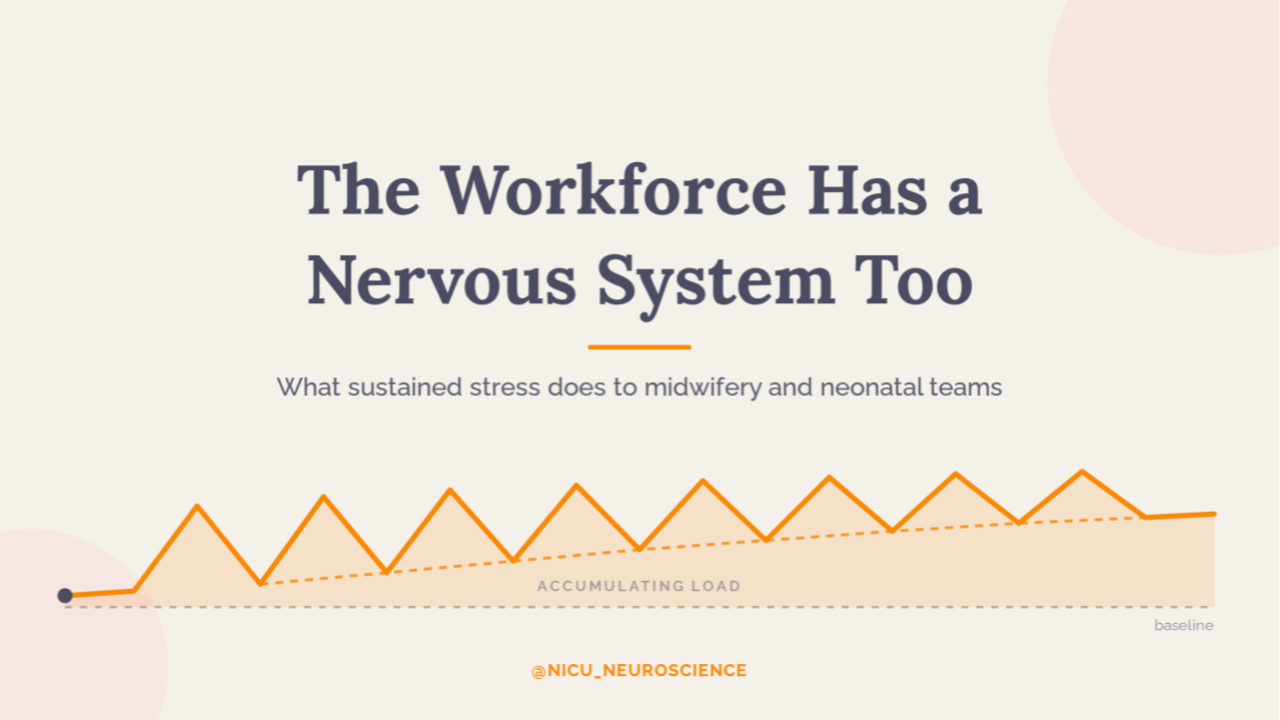
What sustained stress does to midwifery and neonatal teams, and why we need to look at physiology before it becomes culture.
We have become fluent in the language of workforce pressure. We talk about staffing, retention, resilience and burnout, and we tend to frame them as matters of culture, rota gaps, or individual capacity to cope.
All of that is part of the picture. Underneath the culture, though, is something more basic and more measurable. Sustained stress does specific, predictable things to a human nervous system, and midwifery and neonatal teams are asked to work inside exactly the conditions that produce them.
This is not a wellbeing footnote. Burnout in neonatal units is a patient safety issue. Across 44 units, the mean proportion of staff reporting burnout was 25.9 percent, reaching as high as 54.4 percent in some units, and higher burnout tracked with worse safety culture (Profit et al., 2014).
If we want to understand why, we have to look at the biology rather than the character of the people involved.
Allostasis works beautifully, until it cannot switch off
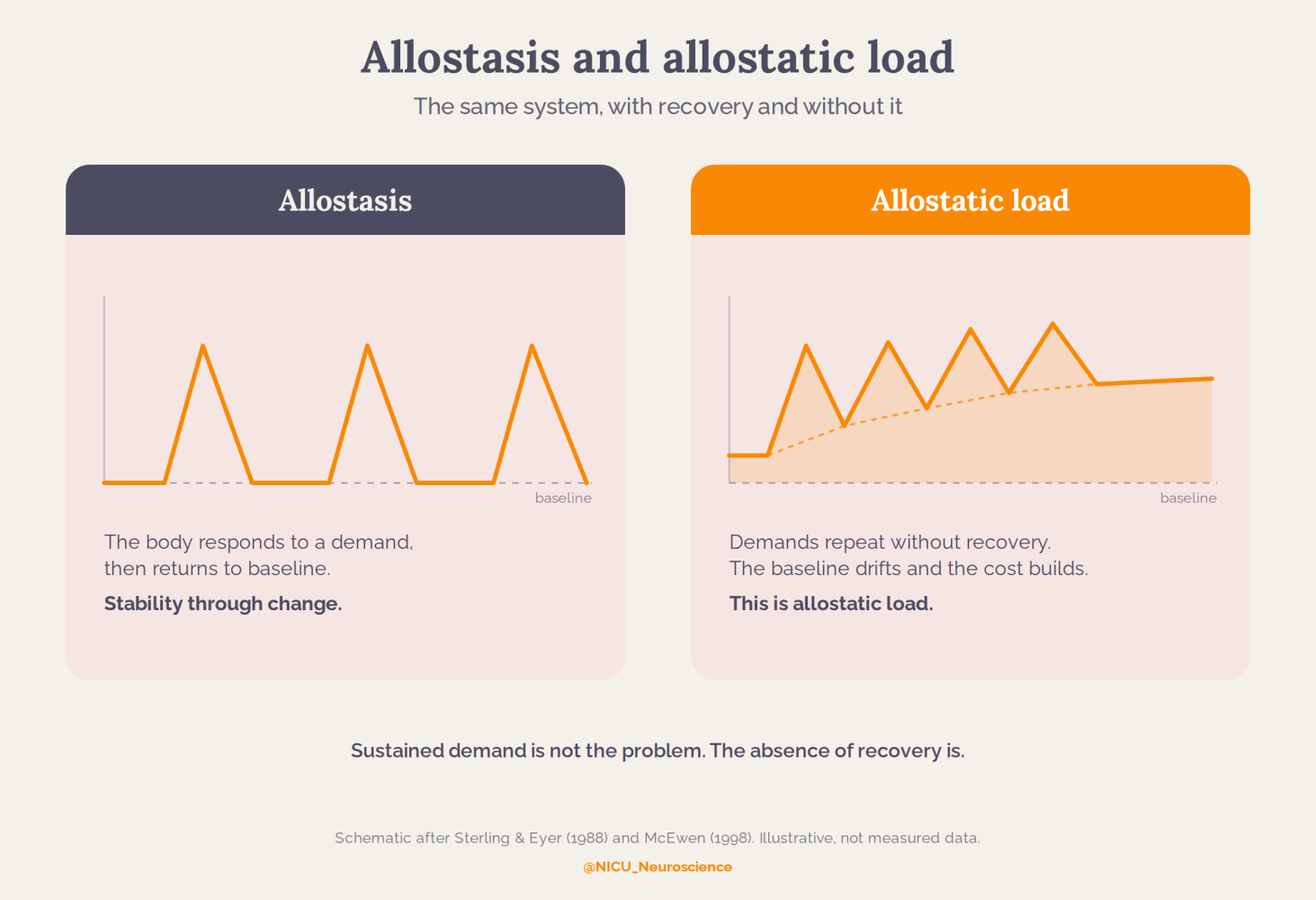
The body does not hold itself at fixed set points. It predicts what it is about to need and adjusts in advance. This is what we call allostasis, stability through change (Sterling and Eyer, 1988; McEwen, 1998).
It is elegant and adaptive, and it is built for a threat that arrives, is dealt with, and passes, allowing the system to return to baseline.
But a busy unit with minimal support does not offer that shape.
Working in neonatal and maternity settings is autonomically expensive. Rapid shifts in acuity, high-stakes decisions, emotional intensity where staff are with families through some of their most vulnerable moments and debilitating experiences. There is also limited time to recover before the next demand arrives.
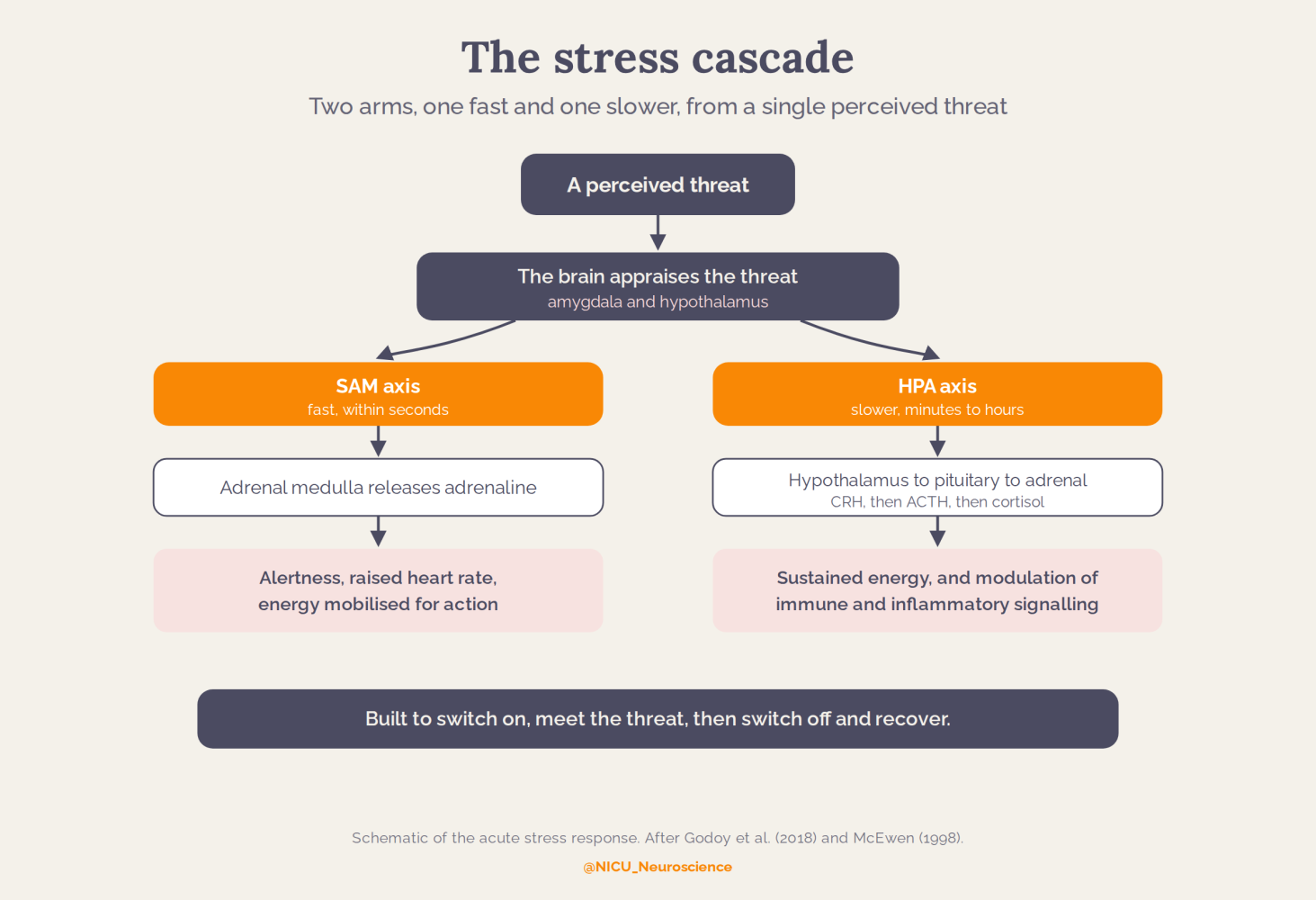
When the stress response is called on repeatedly without sufficient recovery, the system begins to recalibrate. Sympathetic arousal stays elevated, cortisol signalling becomes prolonged or dysregulated, and the feedback loops that normally restore balance start to weaken (McEwen and Stellar, 1993; Guidi et al., 2020).
That shift, from adaptive stress to cumulative wear, is allostatic load.
And I want to be clear about where it comes from when we are looking at this through a systems lens. Rota design, staffing ratios, validation, knowing when to say it is not okay for me to be in work today without feeling like you are letting your team down, or the families down, or for fear of punishment, and access to debrief and psychological safety, are not soft extras sitting alongside the clinical work.
They are allostatic interventions. Team culture is itself a clinical environment, because social-evaluative threat, the sense of being judged or found wanting, reliably activates stress biology.
The shift the body braces for
Here is the part we name least often, and why I want to bring nervous system work to clinical teams.
The autonomic nervous system is always working in service of our safety, before connection can happen. This is crucial, so hold onto it. It routinely asks the question: am I safe? Is there danger here? What is important to note is that the body reads its surroundings for cues of threat and safety long before conscious thought catches up.
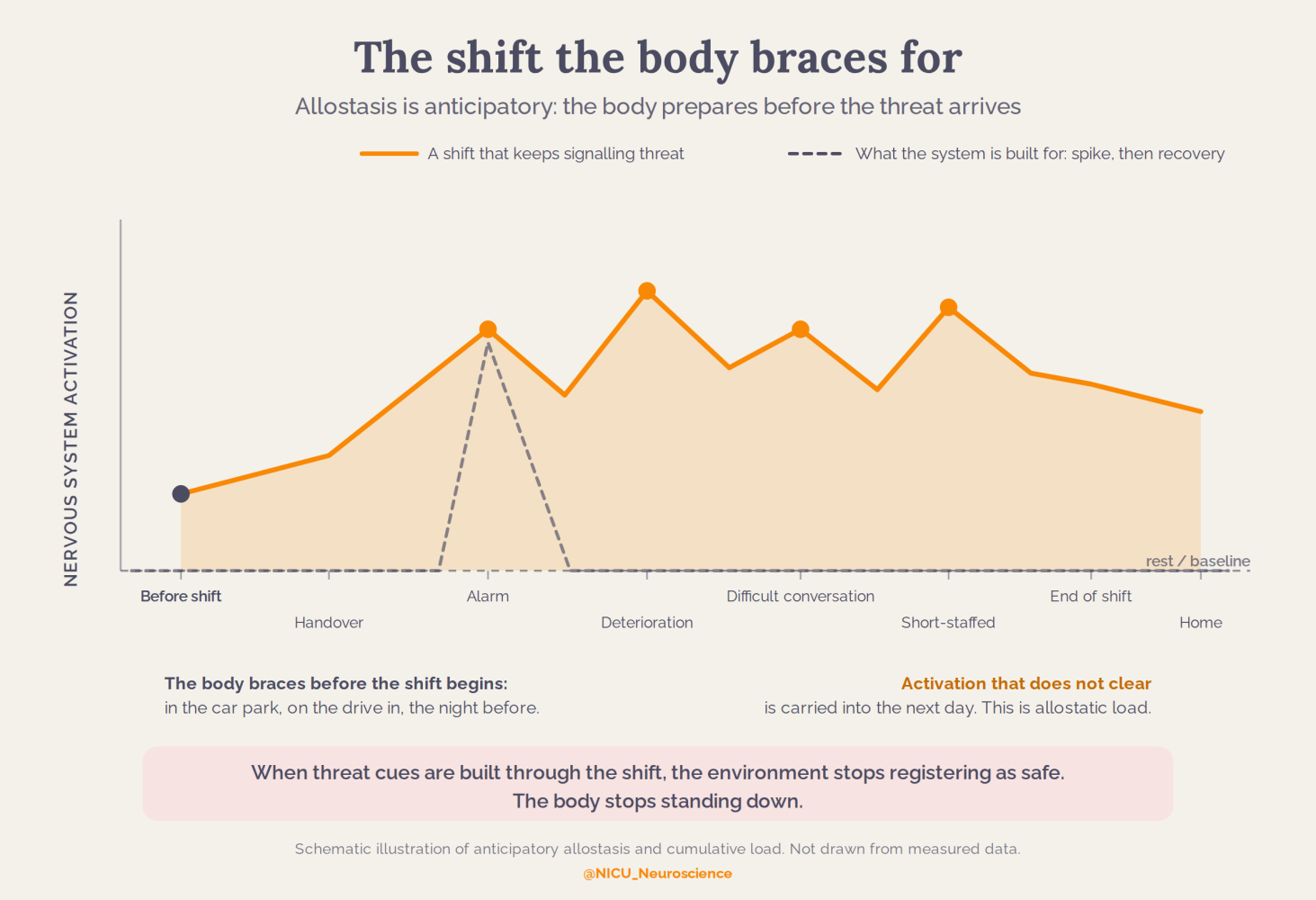
When an environment repeatedly delivers threat cues, a shift can be a near-continuous stream of them. Alarms, deteriorations, emergencies, crash calls, difficult conversations, being short-staffed, at times aggression, the knowledge that any decision may later be scrutinised, lack of support on shift, feeling watched, judged, and ultimately unsafe. This is where the system stops treating that environment as reliably safe.
Because allostasis is anticipatory, the body then starts to prepare in advance.
This is why the bracing so often begins before the shift does. In the car park, on the drive in, the night before. Staff may notice that feeling of dread, an increase in body tension, muscle aches, chronic pain, anxiety, nausea. For many, the profession, the ward, the team may no longer register to the nervous system as a safe place, and the physiology adjusts accordingly, holding a state of prolonged anticipatory threat, alert for long stretches whether or not the feared thing happens.
This is the same architecture we teach clinicians to recognise in parents, a body still braced for danger, but now turned toward the workforce.
And it carries a real energetic cost. Sustained activation raises resting energy expenditure, so the depletion staff describe at the end of a run of shifts is not only emotional. It is a bioenergetic state, the price of a system that has been asked to stay switched on, and to keep anticipating, for too long.
The body is always reporting to the brain
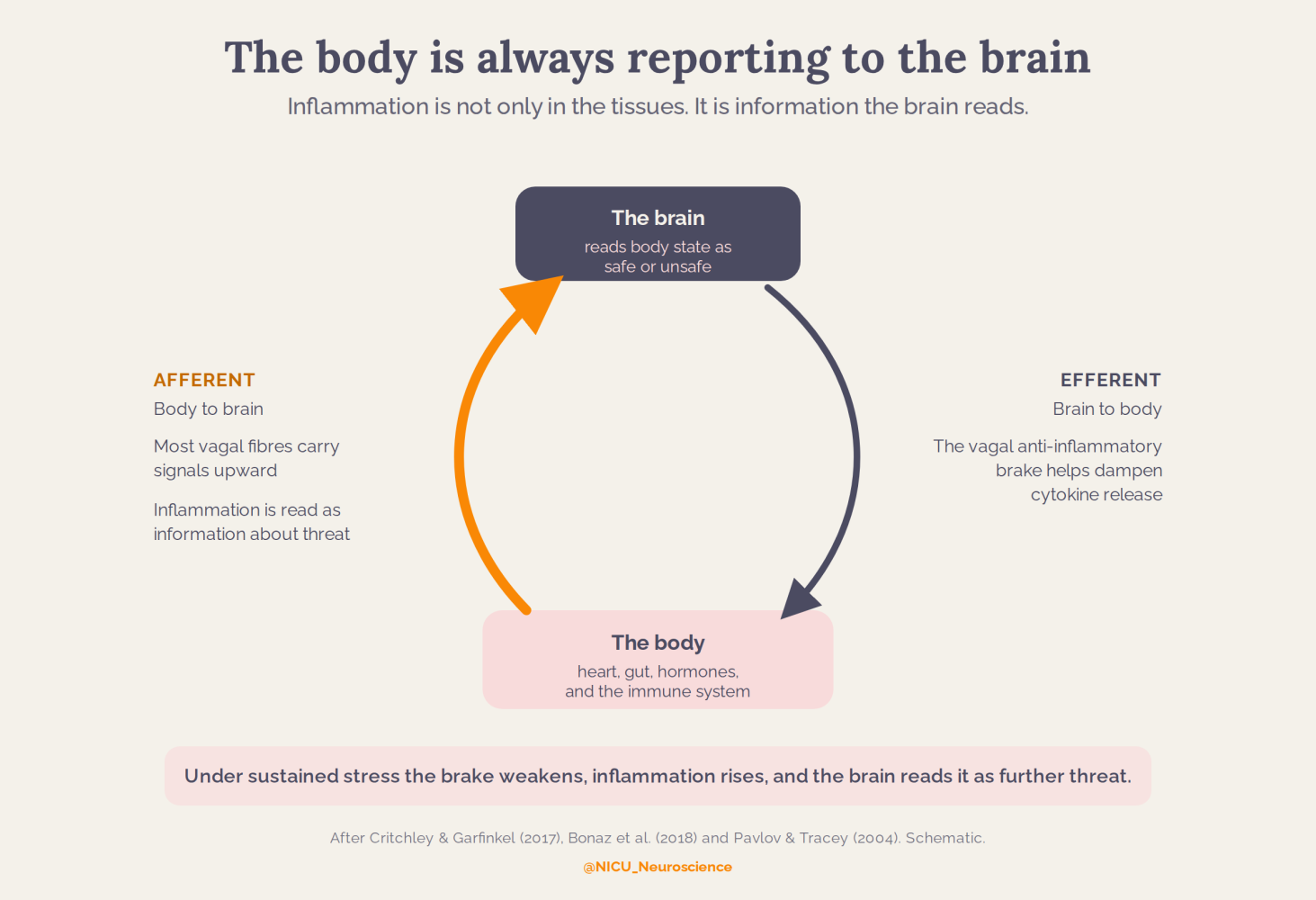
To see where this becomes physical, we need interoception: the brain's sensing of signals from inside the body, including the heart, gut, hormones, temperature and the immune system (Critchley and Garfinkel, 2017; Berntson and Khalsa, 2021).
Most of it runs below awareness. The vagus nerve is a major route, and most of its fibres, around 80 percent, carry information from the body up to the brain rather than the other way around (Bonaz et al., 2018).
Immune signals are part of that report. Inflammation is not only something that happens in the tissues. It is information the brain reads. Vagal signalling can also dampen it, through the cholinergic anti-inflammatory pathway (Bernik et al., 2002; Pavlov and Tracey, 2004).
When a system is chronically stressed and that regulation is reduced, inflammatory signalling can rise, and the brain reads that inflammation as further evidence of threat.
The link between inflammation and mood is real and mechanistically plausible, but to be clear, this is best understood as association and pathway rather than a switch that flips predictably in every person.
Sickness behaviour, and what it can look like
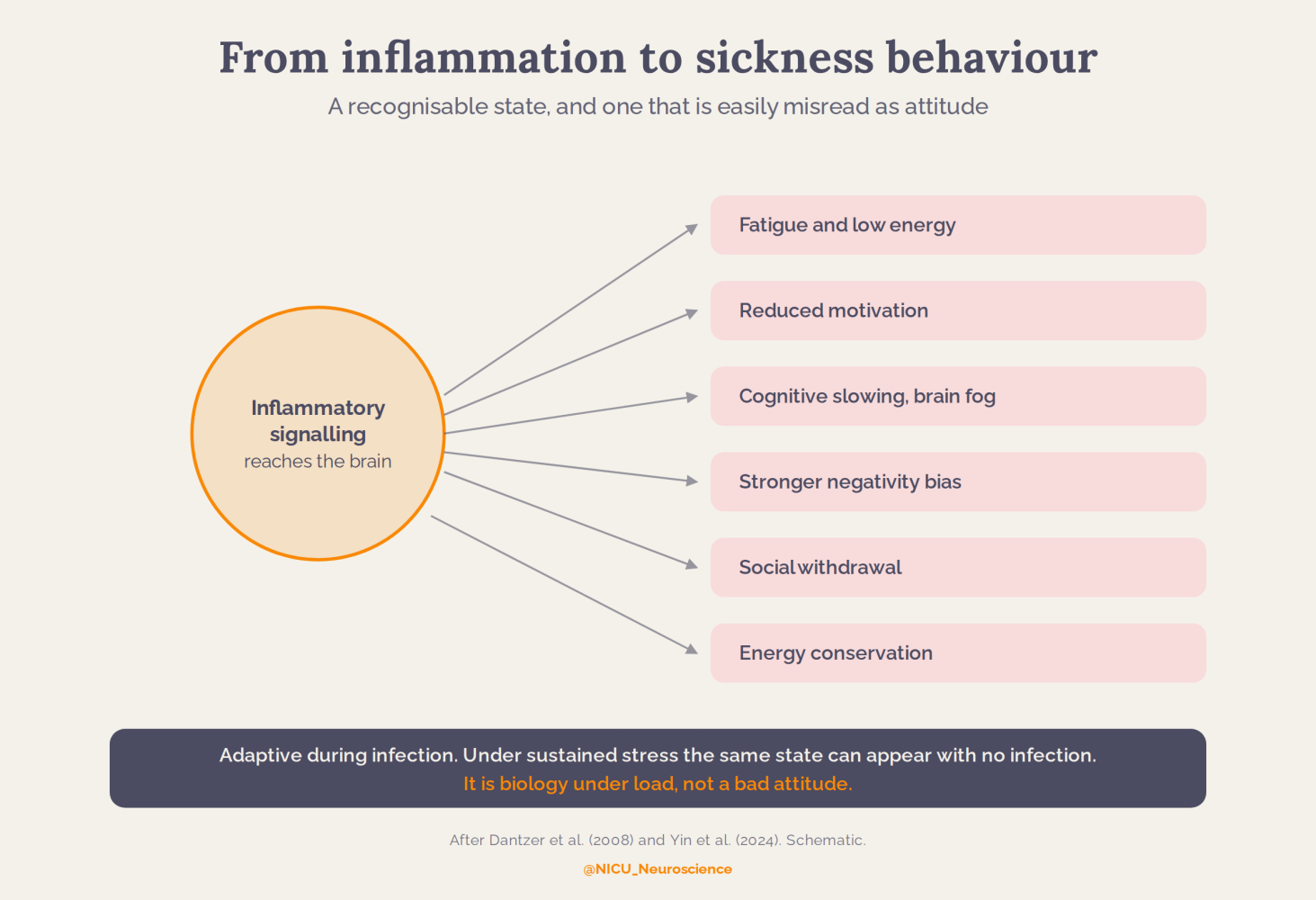
When inflammatory signalling reaches the brain, it can move the brain into a different regulatory state. The recognisable pattern includes fatigue, reduced motivation, cognitive slowing, a stronger negativity bias and a general conservation of energy (Dantzer et al., 2008; Yin et al., 2024).
This cluster has a name: sickness behaviour. During an infection it is adaptive, pulling us toward rest and stillness.
The point for teams is that the same pattern can emerge under sustained stress, with no infection at all.
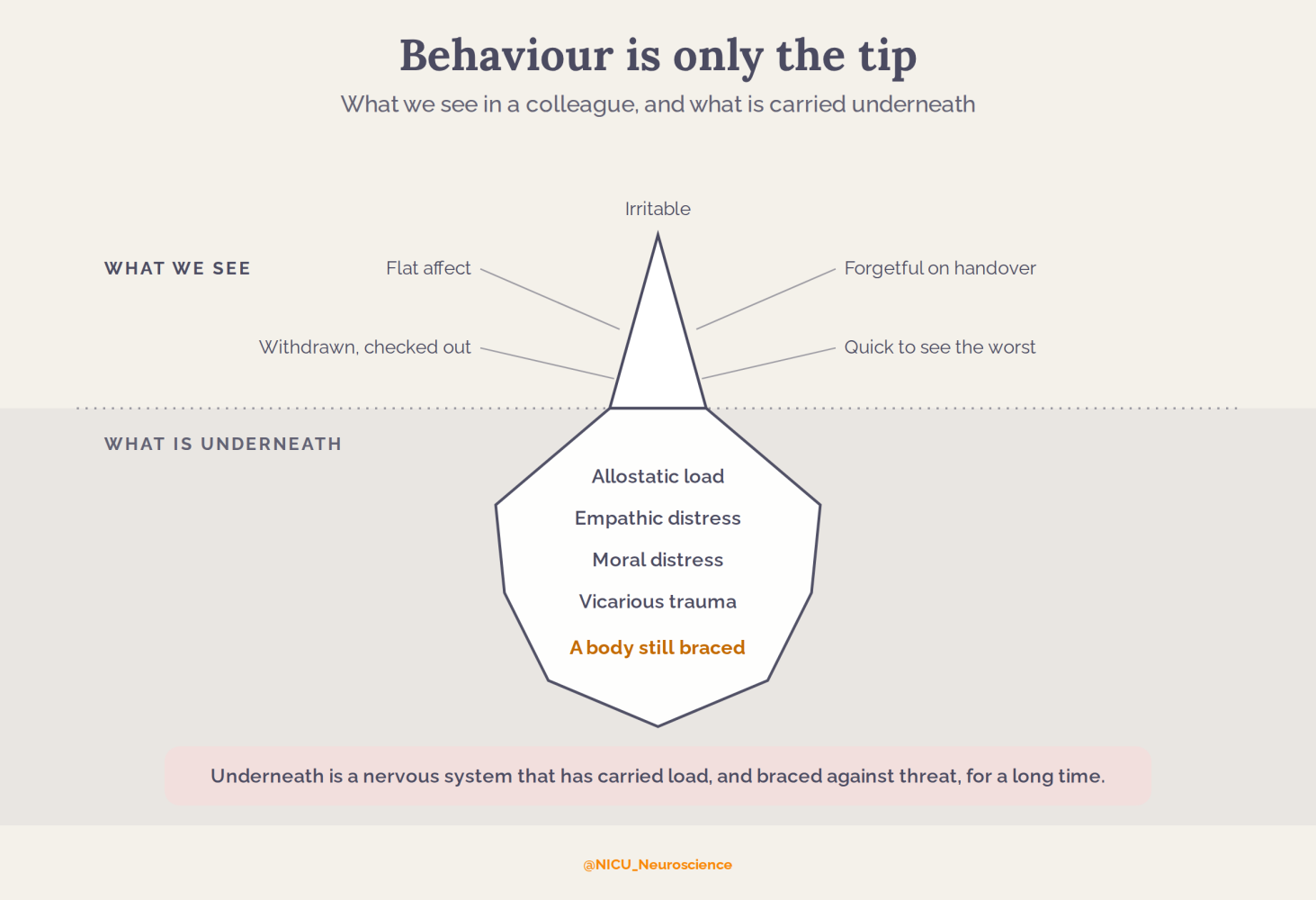
A colleague who seems flat, slow to engage, forgetful on handover, or quicker than usual to see the negative, may not have a poor attitude or be failing to pull their weight. They may be in a biological state produced by load.
The alternative reading is the damaging one, and it is also a safety one, because cognitive narrowing under sustained load is a predictable physiological effect, not a personality trait. When we record it as an attitude, we miss both the person and the risk.
What load looks like in a body
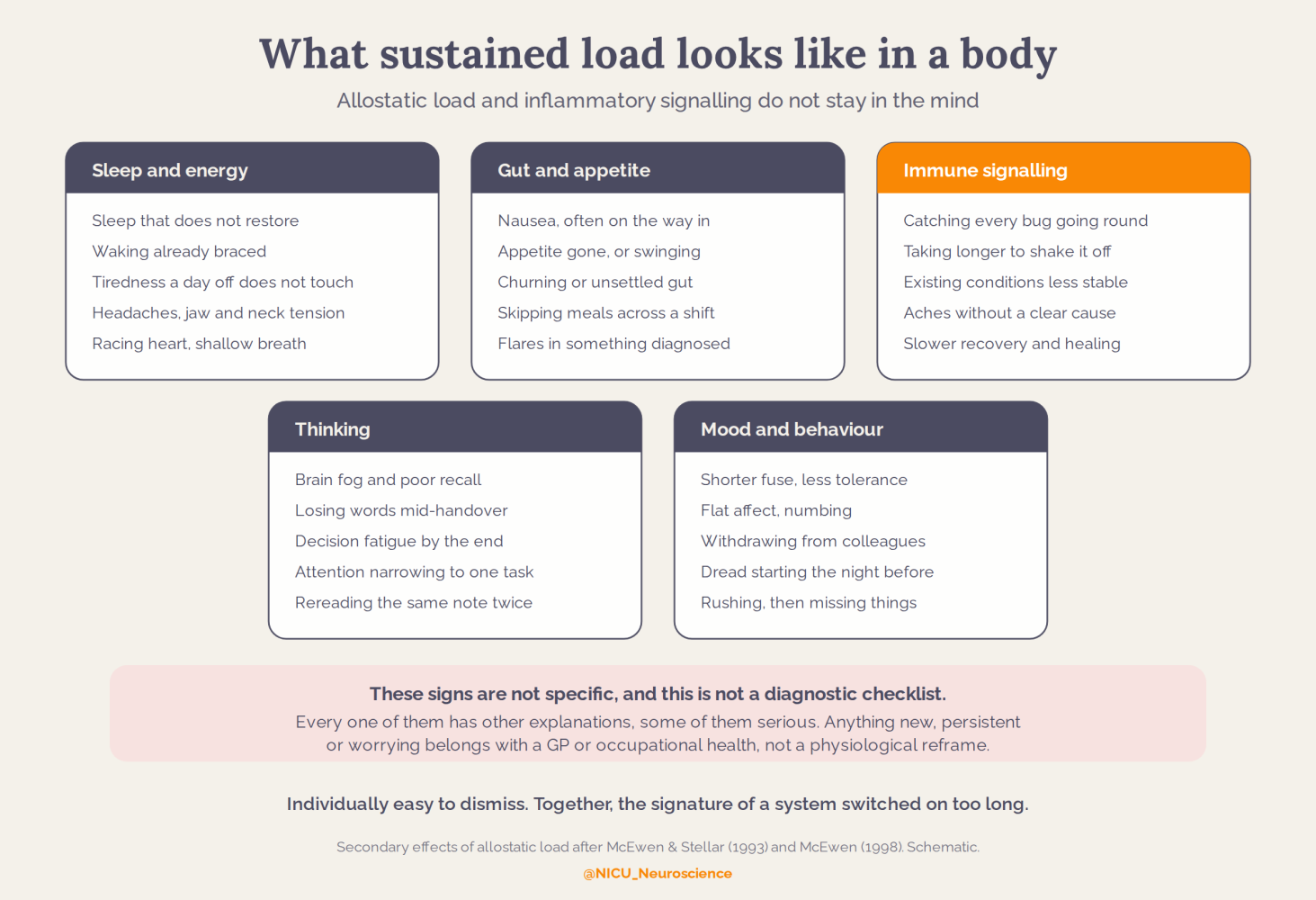
Because this is physiology, it shows up physically, and most of it is easy to attribute to something else. The pattern tends to be recognisable to anyone who has worked a long run in a pressured unit.
Sleep and energy. Sleep that does not restore. Waking already braced. Tiredness that a day off does not touch. Headaches, jaw and neck tension, teeth grinding, a heart that races over nothing.
Gut and appetite. Nausea, often on the way in rather than during the work itself. Appetite gone, or swinging between no hunger and extreme hunger. Reflux, IBS, a change in bowel habits, sudden sensitivity to foods that never bothered you before.
Immune signalling. Catching every bug going and taking longer than usual to shake it off. Existing conditions becoming less stable. Aches, or pain without a clear cause.
Cognition. Brain fog and poor recall. Losing words mid-handover. Decision fatigue by the end of a shift. Attention narrowing to the single task in front of you.
Mood and behaviour. A shorter fuse and less tolerance for small frustrations. Flat facial expressions, monotone voice, withdrawing from colleagues you would normally seek out. Dread that starts the night before.
Two things I need to be clear on about that list.
The first is that none of it is specific. Every one of these signs has other explanations, some of them serious, so this is a prompt to pay attention rather than a way to diagnose yourself or a colleague. Anything new, persistent or worrying belongs with a GP or occupational health, not a physiological reframe.
The second is that this is precisely why the load stays invisible. Each symptom is individually explicable and easy to dismiss or treat in isolation, and most people do dismiss them, one at a time, for months. It is only when they are seen together, as the downstream signature of a system that has been switched on too long, that they read as one thing rather than five unrelated complaints.
Empathic distress: the specific cost of caring
There is a further layer that is particularly important to caring work.
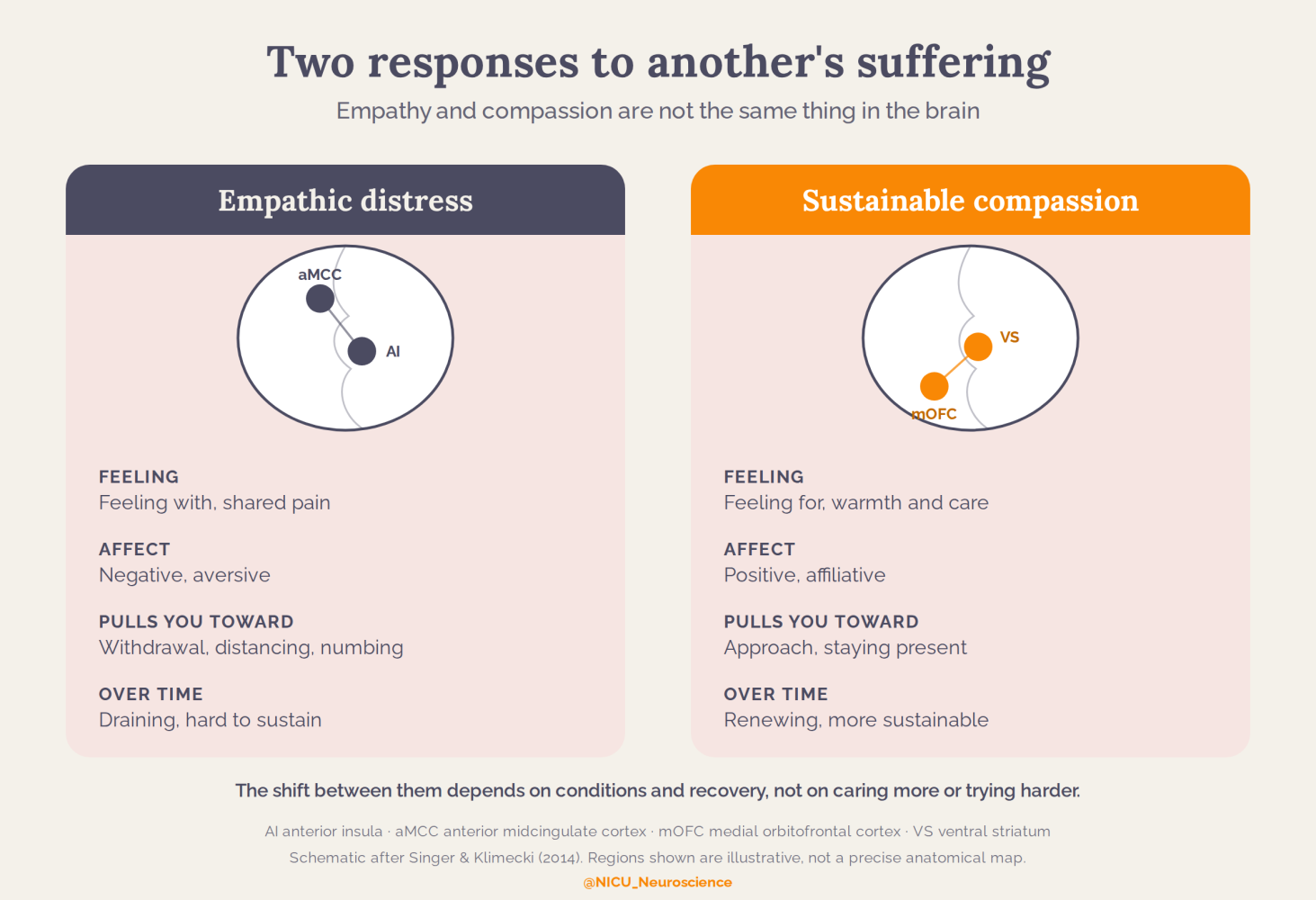
When we witness another person's distress, the anterior insula and anterior cingulate, the very circuitry that handles our own interoception, activate in patterns that overlap with pain. We feel with people. That resonance is the beginning of empathy, but empathy and compassion are not the same thing neurobiologically (Singer and Klimecki, 2014).
Empathic distress is what happens when we resonate with suffering until it becomes personally overwhelming. It is physiologically draining and pulls us toward withdrawal, numbing and distancing.
Sustainable compassion recruits different, approach-related circuitry, and lets us stay present without collapsing into the other person's state.
The move between them is not about caring more or trying harder. It depends on conditions, which is why, without recovery, even the most committed staff trend toward empathic distress over time.
And this is not only a wellbeing point. A depleted nervous system cannot easily co-regulate a frightened one, and staff regulation is itself a cue of safety in the room. Protecting it protects families too.
Vicarious trauma, and the shape of staff trauma
Empathic distress can deepen into something with a traumatic imprint.
Witnessing threat, emergency, deterioration or loss is a recognised pathway to traumatic stress, and neonatal and maternity staff are exposed to it not once but repeatedly (American Psychiatric Association, 2013; Sanders and Hall, 2018). Over time this can produce secondary or vicarious traumatic stress, compassion fatigue, and emotional suppression. I wanted to name this plainly, because it is so often carried in silence.
The important framing is the same one we apply to families. This is cumulative, not a single event. The unit itself can act as a maintenance factor, a place that keeps re-triggering a threat response rather than allowing it to resolve.
And the presentation can mirror the shape of post-traumatic stress even where it does not meet a diagnostic threshold. Intrusive images from a particular shift. Hyperarousal and difficulty switching off. Avoidance of certain rooms or situations. The numbing that makes a clinician feel flat with a family they would normally reach.
This is a set of signals to be recognised with curiosity and compassion rather than judgement, in ourselves and in each other, and it belongs to the whole team, not only to those who were closest to the event.
Moral distress is information, not weakness
Not all of this is fear or fatigue. A distinct layer sits at the meeting point of values and constraint.
Moral distress is the experience of knowing the right thing to do but being unable to do it, and it is significantly associated with emotional exhaustion in neonatal staff (Carletto et al., 2022). Where it accumulates without resolution it leaves a residue that builds over time (Epstein and Hamric, 2009), and where experience collides hard with a person's sense of responsibility it can become moral injury, carrying persistent guilt and difficulty integrating what happened (Litz et al., 2009; Shay, 2014).
Persistent moral distress is not a marker of a fragile individual. It is a system-level signal, information that people are being asked to work in the gap between the care they know is right and the resources they are given to deliver it.
Treated as information, it points toward the conditions that need to change. Treated as weakness, it simply adds shame to load, and compounds the problem we keep seeing routinely.
Why the usual offer may miss the mark
Whichever pressure dominates, sustained stress narrows the window in which a person can stay regulated and think clearly.
This is why instruction does not reach a system running on threat, and why resilience training that asks individuals to absorb a systemic problem so reliably disappoints.
You cannot reason a stressed body calm, and you cannot train an individual out of an environment that keeps generating the load.
Autonomic literacy is a clinical skill, not a wellbeing extra
There is something more useful we can give clinicians, and it is not a coping technique. It is the physiology itself.
Autonomic literacy, the language of the nervous system, means being able to read the nervous system state in a parent, in a colleague, and in yourself, and to understand what follows from it. Framed properly, this is not soft provision. It is competence, and it sits squarely in territory that maternity and neonatal services already fund.
It can change clinical practice. A clinician who can read a parent's state knows that information delivered to a system running on threat will not be retained, and paces accordingly. They recognise that a parent's flat affect may be shutdown rather than disengagement, and document it differently. They understand why the same words land completely differently on day two and day forty.
It is a human factors and safety skill. Cognitive narrowing under sustained load is a known contributor to error. A team that can name attentional narrowing in the moment, in themselves or in a colleague, has a safety mechanism that a fatigue policy alone does not provide. Given the established link between burnout and safety culture in neonatal units, this is a patient safety intervention that happens to also protect staff.
It changes how behaviour is read within teams. Once a team understands sickness behaviour, empathic distress and moral distress, a colleague who is flat, forgetful and short-tempered can stop being a performance concern and becomes a person carrying load. This single reframe can shape how we look after our teams.
A shared language makes invisible load visible
The second thing autonomic knowledge gives a workforce is vocabulary, and this may matter more than the science.
The language we currently have is binary and identity-laden. Coping or not coping. Resilient or burnt out. Fine or struggling. These are judgements about a person's character, which is exactly why people will not use them about themselves. Admitting you are burning out feels like admitting you are not built for the job.
State language does something different. "I am feeling mobilised." "My window is narrow today." "I need ten minutes before I go back in."
These describe a temporary physiological condition rather than a permanent personal failing, and because they are non-blaming, my hope is people will actually say them out loud.
That has practical consequences. A charge midwife who hears "my window is narrow today" can redistribute the difficult conversation. A team that has language for state can flag load before it becomes a long-term sickness absence. And leaders gain something they currently do not have: real-time information about where the load is sitting.
What it could look like on a unit
None of this requires a new department. It requires the physiology to be taught early, and the working day to be built as though it were true.
- Induction and preceptorship. Teach it before the bracing sets in, not as a rescue after someone is already struggling. New staff should learn what the environment will do to their physiology at the same time they learn the clinical protocols.
- Handover. One line about state alongside the clinical events. It takes seconds and it normalises the vocabulary.
- Debrief. Timed to allow activation to resolve rather than deferred to a date that never comes. The purpose is completing the stress cycle, not reviewing the clinical decisions, and the two are different meetings.
- Micro-recovery built into the structure. Recovery that depends on individual initiative will not happen on a busy shift. It has to be designed in, and because the body braces in anticipation, recovery between shifts matters as much as recovery within them.
- Peer support and bereavement roles. These people carry the highest exposure to witnessed distress. They need training in the difference between empathic distress and sustainable compassion, and supervision that assumes accumulation.
- Escalation and difficult conversations. Paced with state in mind, on both sides of the conversation.
Who is holding the holders?
Allostatic load, inflammation, sickness behaviour, empathic distress, vicarious trauma and moral distress are not separate problems. They are one continuous piece of physiology, seen from different angles, playing out in the bodies of the people who hold everyone else.
The midwife who braces on the drive in, and the neonatal nurse who is exhausted, forgetful and quick to see the worst, are not failing. They are showing us a workforce that has been carrying load, and bracing against threat, for a long time.
We already accept that understanding infant physiology is core clinical knowledge. We are beginning to accept that understanding parental physiology changes the care we give. The missing piece is the third nervous system in the room, the one belonging to the person delivering the care, and it has been treated as a wellbeing afterthought rather than as part of the clinical picture.
Giving clinicians the physiology does two things at once. It makes them better at reading state in the families they care for, which is a clinical gain. And it gives them a non-blaming language for their own experience, which is what makes load visible early enough for anyone to act on it.
Neither of those replaces a workable rota or resolves staffing worries. Both make it far harder to pretend that depletion is a character flaw.
If we are serious about trauma-informed, family-integrated care, we cannot deliver it from a depleted, braced workforce and keep locating the problem in the individuals who are struggling. When we learn to read the body first, in our teams as well as in our families, we stop asking people to be different and start changing what we ask of them.
The question worth keeping in front of us is a simple one. Who is holding the holders?
My latest staff handout combines information about the parental autonomic nervous system with a way for staff to map their own. If you would like to use it to support yourself or your team, you can download it free here.
Lottie
References
American Psychiatric Association. (2013). Diagnostic and Statistical Manual of Mental Disorders (5th ed.).
Berntson, G. G., & Khalsa, S. S. (2021). Neural circuits of interoception. Trends in Neurosciences, 44(1), 17-28.
Bernik, T. R., et al. (2002). Pharmacological stimulation of the cholinergic anti-inflammatory pathway. Journal of Experimental Medicine, 195(6), 781-788.
Bonaz, B., Bazin, T., & Pellissier, S. (2018). The vagus nerve at the interface of the microbiota-gut-brain axis. Frontiers in Neuroscience, 12, 49.
Carletto, S., et al. (2022). Moral distress and burnout in neonatal intensive care unit healthcare providers.
Critchley, H. D., & Garfinkel, S. N. (2017). Interoception and emotion. Current Opinion in Psychology, 17, 7-14.
Dantzer, R., et al. (2008). From inflammation to sickness and depression. Nature Reviews Neuroscience, 9(1), 46-56.
Epstein, E. G., & Hamric, A. B. (2009). Moral distress, moral residue, and the crescendo effect. Journal of Clinical Ethics, 20(4), 330-342.
Guidi, J., et al. (2020). Allostatic load and its impact on health. Psychotherapy and Psychosomatics, 90(1), 11-27.
Litz, B. T., et al. (2009). Moral injury and moral repair in war veterans. Clinical Psychology Review, 29(8), 695-706.
McEwen, B. S. (1998). Stress, adaptation, and disease: allostasis and allostatic load. Annals of the New York Academy of Sciences, 840(1), 33-44.
McEwen, B. S., & Stellar, E. (1993). Stress and the individual: mechanisms leading to disease. Archives of Internal Medicine, 153(18), 2093-2101.
Pavlov, V. A., & Tracey, K. J. (2004). Neural regulators of innate immune responses and inflammation. Cellular and Molecular Life Sciences, 61, 2322-2331.
Porges, S. W. (2004). Neuroception: a subconscious system for detecting threats and safety. Zero to Three, 24(5), 19-24.
Profit, J., et al. (2014). Burnout in the NICU setting and its relation to safety culture. BMJ Quality & Safety, 23(10), 806-813.
Sanders, M. R., & Hall, S. L. (2018). Trauma-informed care in the NICU. Journal of Perinatology, 38(1), 3-10.
Shay, J. (2014). Moral injury. Psychoanalytic Psychology, 31(2), 182-191.
Singer, T., & Klimecki, O. M. (2014). Empathy and compassion. Current Biology, 24(18), R875-R878.
Sterling, P., & Eyer, J. (1988). Allostasis: a new paradigm to explain arousal pathology. In S. Fisher & J. Reason (Eds.), Handbook of Life Stress, Cognition and Health.
Yin, R., et al. (2024). Inflammation and sickness behaviour.